






Contents
Share


Japan has been experiencing increasingly severe damage from torrential rainfall triggered by typhoons and stationary linear rain bands. In response, an ambitious and unconventional idea is taking shape: artificially inducing heavy rainfall over the ocean to reduce extreme downpours on land. This pioneering project was selected for the Cabinet Office’s Moonshot Research and Development Program and is led by Professor Shunji Kotsuki of the Institute for Advanced Academic Research/Center for Environmental Remote Sensing, who serves as project manager.
While Professor Kotsuki runs his laboratory and discussions with rigorous logic, he is guided by a clear belief: “When you aim to accomplish something meaningful, it ultimately comes down to passion and energy.” In this interview, we spoke with him about the current state of weather control and AI-based weather forecasting research, as well as the mindset that underpins his pursuit of challenging, future-oriented science.
Triggering rain over the ocean by tapping into the ‘Key’ to weather control
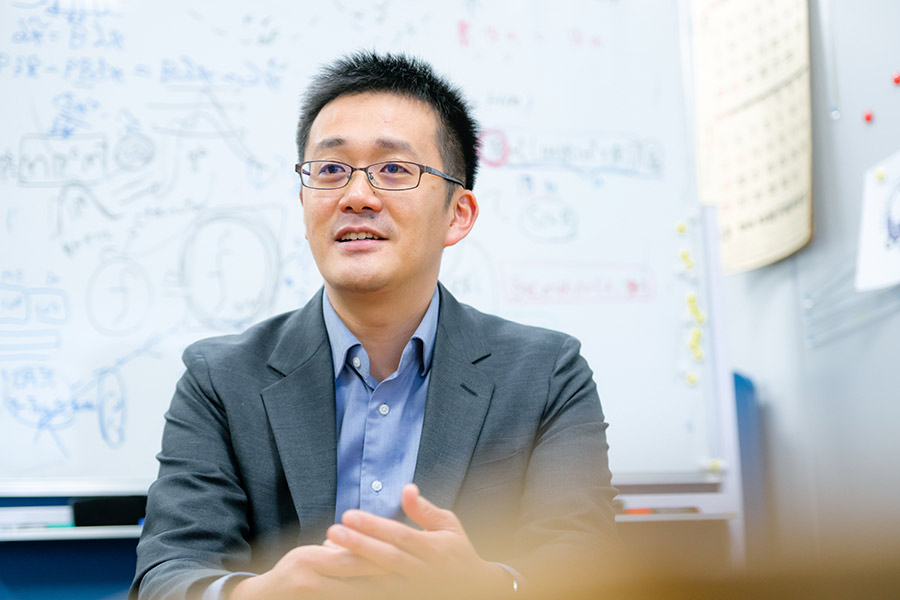
Could you tell us about the work you are pursuing under the Moonshot Research and Development Program?
As part of Moonshot Goal 8, entitled “Realization of a society safe from the threat of extreme winds and rains by controlling and modifying the weather by 2050,” I am leading a project called “Artificial generation of upstream maritime heavy rains to govern intense-rain-induced disasters over land (AMAGOI).”
In Japan, flood damage can exceed one trillion yen in severe years, and such disasters can even result in loss of life, making them a major social challenge. At the same time, there are clear limits to conventional hardware-based countermeasures, such as flood-control dams and levees. The torrential rains that have caused the most serious damage in Japan have been driven primarily by significant inflows of water vapor from the ocean. Based on this understanding, our approach is to artificially induce cumulonimbus cloud formation over the sea, triggering heavy rainfall in advance. By doing so, we aim to reduce the amount of water vapor reaching land and ultimately mitigate the risk of extreme rainfall disasters over populated areas.
Is this actually possible?
Weather is inherently chaotic—even the slightest change can dramatically alter what happens next. Once torrential rain has already begun, it is almost impossible to intervene artificially. However, we believe that intervening early with minimal yet well-targeted actions can yield significant effects. I refer to this approach as ‘identifying the key control points’ in the weather system. From a data science perspective, determining where these control points lie—and how to intervene effectively—is central to weather control and represents a fascinating scientific challenge. Numerical simulations conducted so far suggest that it may be possible to reduce torrential rainfall by 10-20%.

Based on these simulation results, I am planning to conduct an experimental artificial rainfall trial over the ocean in FY 2025. In this experiment, dry ice will be dispersed from an aircraft, serving as a nucleus for water vapor, thereby inducing precipitation. The goal is to reduce the amount of water vapor that ultimately flows onto land.
One of the most significant technical challenges lies in accurately reproducing current weather conditions within numerical models. Real-time weather data collected from various observation systems must be assimilated into simulations that represent the evolving atmosphere. Based on this reconstructed state, we calculate where dry ice should be dispersed before determining the actual release points. Reconstructing the whole atmospheric system from partial observational data is highly challenging, and this is an area where I also anticipate making extensive use of AI.
In addition, I am exploring the concept of an offshore dome structure. This would involve constructing a triangular structure approximately 600 meters wide and 300 meters high, designed to redirect wind flow and induce rainfall over the ocean, thereby reducing precipitation over land. I am currently working with a manufacturing partners to assess the technical feasibility of this concept and to identify the required engineering standards.
AI is transforming weather forecasting
Do you expect AI to play a role in weather forecasting in the future?
AI-based weather forecasting is one of our research competencies. As this technology advances, we expect significant improvements in predicting linear precipitation bands—phenomena that are currently very difficult to forecast accurately.
Today’s weather forecasts rely on ‘numerical weather prediction,’ which uses supercomputers to simulate atmospheric behavior based on physical laws and observational data. For example, typhoon track forecasts are issued every three hours up to 24 hours ahead, and every six hours up to 120 hours ahead. These forecasts are calculated by running 21 different scenarios and statistically processing the results. While increasing the number of scenarios improves accuracy, it also dramatically increases computational cost and processing time.
Our AI-based approach aims to replace much of this heavy computation. By using AI, we hope to calculate 1,000 scenarios in a short time and update forecasts every 30 minutes.
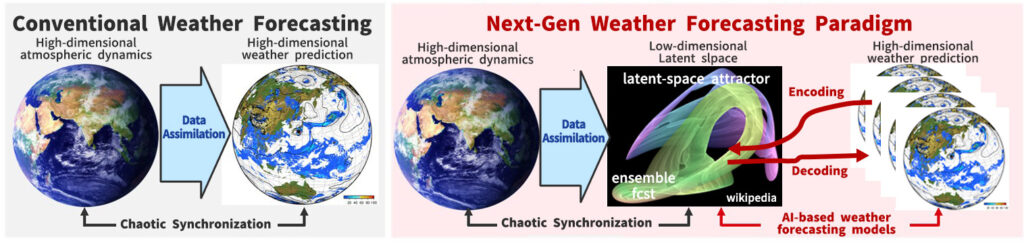
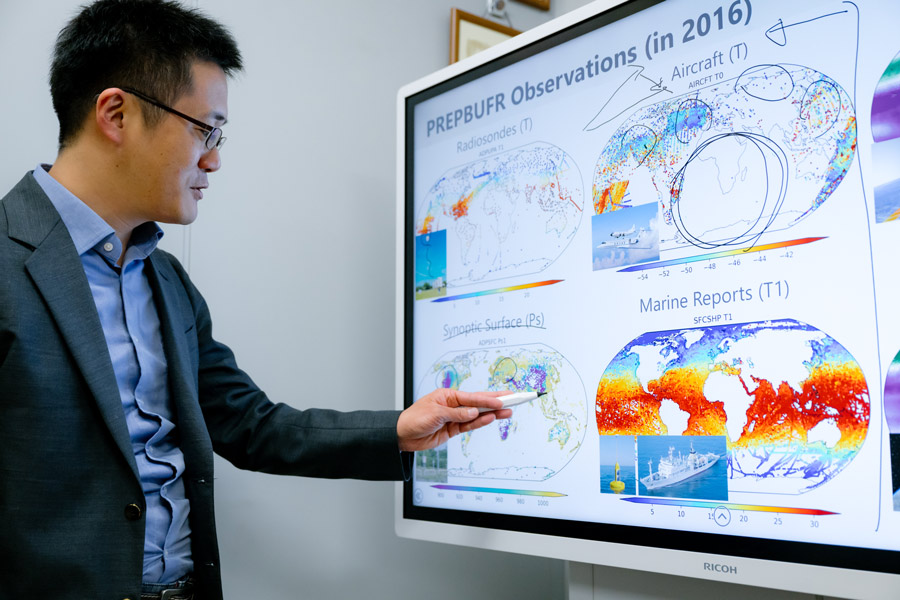
Another major challenge with current forecasting models is that they fail to fully utilize available observational data. In fact, only about 5 to 6% of available meteorological data is currently used in operational weather prediction. If we can incorporate the vast amount of unused observational information, forecasts will become more sophisticated and significantly more accurate.
Why is observational data so underutilized?
Weather forecasting involves two key components: One is a mathematical method used to estimate the current state of the atmosphere, and the other is a predictive model that forecasts future conditions based on that current state. The technology used for the former is known as ‘data assimilation.’ It modifies simulation results so that they better match real-world observational data, allowing us to estimate and forecast atmospheric conditions that are closer to reality. However, there is a major challenge: data assimilation becomes increasingly complex as the volume of observation data grows. When too much data is available, incorporating it efficiently into simulations can be computationally complex and time-consuming. We believe this is an area where AI has significant potential to achieve a breakthrough.
In addition, by using explainable AI (XAI), we can identify which data the AI relied on when making its predictions. This not only improves transparency but also helps deepen our understanding of meteorological phenomena.
*XAI: AI technologies designed to address the black box problem of conventional AI systems. While traditional AI can provide answers, it is often difficult to understand why it arrived at a particular decision. XAI makes the reasoning process visible by clearly showing the basis for AI’s conclusions.
Thinking in frames: What I learned from Takeshi Okada, former head coach of Japan’s national soccer team
You started your lab at Chiba University in 2020. Has your mindset changed over the past five years?
More than ever, I now see my role as developing the next generation of leaders—people who can step into society and operate independently. Rather than simply ‘teaching’ knowledge, I try to coach by providing frameworks for thinking and by building systems that encourage each individual to think for themselves.
Over the past five years, the lab has certainly produced achievements and grown through my teaching. However, I have come to realize that if I continue with the same teaching-centered approach, the lab will never exceed my own capabilities. To become a truly world-leading lab, we must grow into something that surpasses me. Teaching inherently comes with authority, and to be honest, letting go of that control is frightening. Still, I believe in the creativity and sense of responsibility of our younger members, and I feel that now is the right time to shift from ‘teaching’ to ‘coaching.’
The shift was inspired by a story shared by Takeshi Okada, former head coach of Japan’s national soccer team. He once said that building a strong team requires players who can think independently, rather than simply following instructions from a manager or coach. Paradoxically, people don’t act independently if they are given complete freedom from the start. Instead, a basic pattern must first be drilled into them; only then can they think and act freely. Okada referred to this as ‘guidance by principles.’
I intuitively felt that ‘guidance by principles’—which shows the path to arriving at an answer— is more important than guidance by situation, which simply provides the answer itself. In 2025, I incorporated this idea into the operation of my lab. Since then, students and researchers who learned these basic patterns through idea-generation frameworks have become capable of formulating hypotheses and charting their own research paths. I believe this has led to freer thinking and stronger research outcomes.
In addition, the students have taken the initiative to consolidate lab notes, task management records, and other materials into a shared cloud-based system. This allows any lab member to access accumulated knowledge, and future members can trace the thinking processes of those who came before them. Seeing young researchers take ownership in this way has been deeply encouraging.
It seems that the overall capabilities of your laboratory have been steadily improving.
Yes. When I established my lab at Chiba University, my goal was to become number one in Japan within five years and number one in the world within ten years. Looking back now, I believe we may have reached a top-tier position in Japan in the fields of AI and geoscience. That said, I never want to lose a sense of challenge. My goal is to continue pushing ourselves so that we can become number one in the world within the next five years.
As a project manager for the Moonshot Project, I imagine the challenges are quite different from running a laboratory. How do you see it?
That’s true. There are 30 project investigators, each working with their own students and researchers, so in total, I am involved with around 150 people. To be honest, I had never managed anything on this scale before, so it has been quite challenging. That said, I feel that we have gradually developed a strong sense of teamwork.
One important thing I have learned is that you don’t need to be knowledgeable about everything yourself. What matters is trusting the person who is promoting each issue and having the confidence to leave it to them. While our relationship is professional, we also try to understand one another as people. The other day, we had a meeting late at night, and halfway through it turned into a conversation about personal worries and life in general. It felt almost like the night before a school festival—surprisingly fun and energizing. Experiences like that remind me how important it is to engage with others as people and to understand their values, not just through theories such as management theory, but through genuine human interaction.
“The soul of the game lies in the details” —Passion earns the outcome—
Finally, do you have a message for students and young researchers?
If you want to accomplish something meaningful, it is ultimately your passion and energy that determine the outcome. Kazuo Inamori, the founder of Kyocera Corporation, once said that the results of work are determined by mindset, ability, and effort. Among these, I believe passion plays a decisive role. No matter how talented a person may be, without passion, their ideas and insights will never be fully realized.
In research, I believe that what matters more than intelligence is whether you can pursue what you believe is important and continue moving forward in the face of difficulty. In recent years, there has been a strong emphasis on efficiency, cost-effectiveness, and speed. However, I think we’re entering an era where we need to reconsider whether this way of thinking is truly efficient in the long run. If you live with efficiency as your top priority, you tend to focus only on what is immediately relevant to you, and your research perspective becomes narrow. Exploring topics outside your own fields or engaging in interdisciplinary collaboration may seem inefficient in terms of time, but it is precisely through such interactions that ideas and results emerge—things that could never be achieved alone. The accumulation of these experiences is what ultimately leads to innovation.
One phrase I always keep in mind is: “The soul of the game lies in the details.” Opportunities do not come to those who fail to give their best to the task at hand. Rather than worrying too much about cost-effectiveness or timeliness, I encourage young researchers to always give their full effort, one step at a time.
● ● Off Topic ● ●
Your lab’s website is quite distinctive. It is filled with resources for students, such as guidance on how to write academic papers.
I did hesitate about making all of it public at first. However, I decided to do so because I wanted to contribute to science in Japan as a whole. I also hope that people who come across the site and think, “This is the lab to go to,” will feel encouraged to reach out.
There seems to be a strong culture in your lab where students are proactive and take on new challenges.
That’s true. For example, we are currently working toward obtaining a patent related to AI-based weather forecasting technology. The idea didn’t originate from me—it was proposed by students and young researchers who felt it would be exciting to explore. People with diverse backgrounds and skill sets bring their ideas together, and something new emerges from that collaboration. Watching students enjoy the process as they expand the scope of their activities is one of the most rewarding parts of running the lab.
Recommend
-

Unlocking the Potential of Plant Molecules: Charting a New Continent in Natural Products Biology
2024.09.30
-
Harnessing CO2 with a Photocatalyst for Fuel and Plastic Feedstocks: Advancing a Sustainable Society with Chemistry
2023.06.22
-

Bringing Japan’s renowned experiment-based science education to Southeast Asia: Developing sustainable physics teaching materials for the pursuit of a disparity-free society
2023.11.24

