






Contents
Share


The method uses circularly polarized light to reveal the unique magnetic structure of altermagnets, which is unobservable with conventional techniques
Altermagnets, a promising new class of magnetic materials for next-generation spintronics, have remained difficult to identify due to their self-canceling magnetic structure. A new technique developed at Chiba University solves this by detecting distinct signatures produced when the atoms are hit with circularly polarized light. Validated in manganese telluride, a well-known altermagnet, the method opens the door to discovering new altermagnetic materials and enabling the development of faster, energy-efficient spintronic devices.
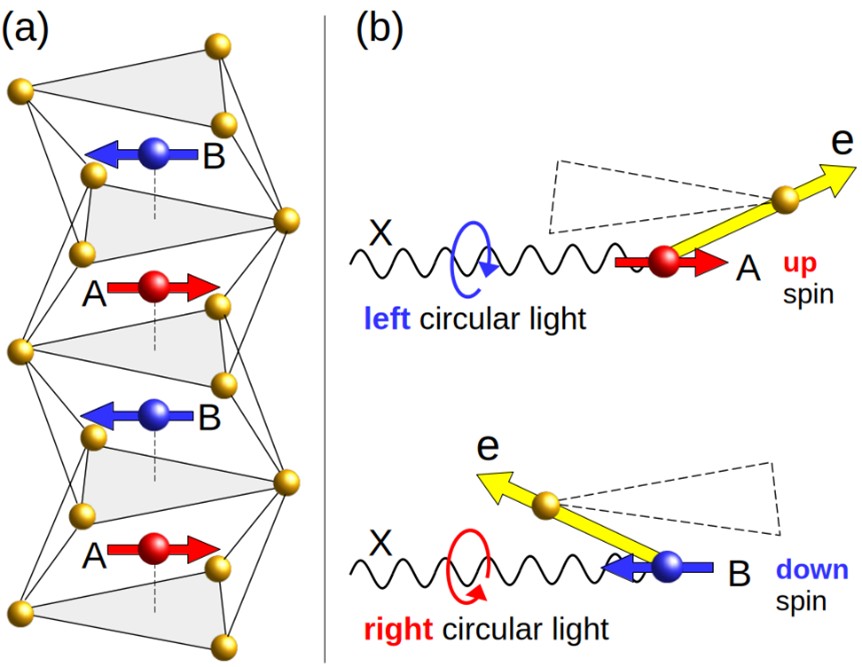
Image title: Uncovering altermagnetism in manganese telluride (MnTe)
Image caption: Figure (a) shows the crystal and spin structure of MnTe, with manganese atoms in red and blue and tellurium atoms in yellow. Figure (b) illustrates how circularly polarized light produces distinct photoelectron diffraction patterns. Left-circular polarization enhances emission from the spin-up sublattice (A), while right-circular polarization enhances emission from the spin-down sublattice (B) in the opposite direction. The resulting circular dichroism reveals the opposite spin orientations of the sublattices.
Image credit: Professor Peter Krüger from Chiba University, Japan
Image license: Original content
Usage restrictions: Cannot be reused without permission.
Altermagnets are a newly recognized class of antiferromagnets whose magnetic structure behaves very differently from what is found in conventional systems. In conventional antiferromagnets, the sublattices are linked by simple inversion or translation, resulting in spin-degenerate electronic bands. In altermagnets, however, they are connected by unconventional symmetries such as rotations or screw axes. This shift in symmetry breaks the spin degeneracy, allowing for spin-polarized electron currents even in the absence of net magnetization.
This unique property makes altermagnets exciting candidates for spintronic technologies, a field of electronics that utilizes the intrinsic spin of the electrons, rather than just their charge, to store and process information. As spins can flip or switch direction extremely quickly, materials that allow spin-dependent currents could enable faster and more energy-efficient electronic devices.
Yet, confirming whether a material is truly altermagnetic is difficult. Even for well-studied candidates like ruthenium dioxide, researchers still disagree about whether it exhibits altermagnetism. This uncertainty highlights the need for experimental methods capable of directly revealing the magnetic arrangement of the sublattices in altermagnetic compounds.
Now, Professor Peter Krüger at the Graduate School of Engineering and Molecular Chirality Research Center, Chiba University, Japan, has developed a way to finally detect this hidden magnetic structure. By using a technique called resonant photoelectron diffraction (RPED), together with circularly polarized light, he discovered that altermagnets produce a unique “magnetic circular dichroism (CD)” signal in their diffraction patterns—one that changes sign when the handedness of the light wave is reversed. This response directly exposes the magnetization of each individual sublattice, making the hidden altermagnetic structure visible. The study, made available online on November 06, 2025, and published in Volume 135, Issue 19 of the journal Physical Review Letters on November 07, 2025, was selected for the “Featured in Physics” section for its high interest and broad potential impact.
“I devised a new method for measuring the magnetic properties of these new materials, specifically the orientation and size of atomic magnetic moments. With this method, it becomes possible to detect altermagnetism in nano-structured materials, especially thin films, where traditional methods such as neutron scattering fail,” says Prof. Krüger.
The method builds upon X-ray magnetic CD (XMCD), which measures how magnetic atoms absorb left- and right-circularly polarized X-rays differently. However, XMCD generally falls short for altermagnets because the magnetic moments on the A and B sublattices are equal and opposite, causing their signals to cancel.
CD-RPED solves this by merging XMCD with photoelectron diffraction (PED). PED works by ejecting electrons with X-rays; as these electrons escape, they scatter off nearby atoms, creating a unique diffraction pattern for each atomic site. By tuning the X-ray energy to a resonance of the magnetic atom, the intensity of the diffraction pattern becomes sensitive to the direction of the local magnetic moment. As a result, the patterns produced by left- and right-circularly polarized light differ, giving each sublattice its own magnetic signature.
The method was validated using manganese telluride, a well-established altermagnet. The analysis reveals a 180-degree flip in the diffraction pattern under opposite circular polarizations, producing a clear dichroism signal that confirms the proposed technique’s ability to detect altermagnetic order.
“We have shown that the occurrence of magnetic CD in RPED is a direct consequence of the XMCD on each magnetic sublattice and the fact that in an altermagnet, the two sublattices necessarily have distinct PED patterns,” says Prof. Krüger.
This breakthrough makes it possible to definitively identify altermagnetism in surfaces, interfaces, and thin films, systems where conventional magnetic probes often fail. Looking ahead, the ability to determine altermagnetic order at the atomic level is expected to accelerate the search for new altermagnetic materials and support the development of future spintronic technologies.
To see more news from Chiba University, click here.
About Professor Peter Krüger from Chiba University, Japan
Dr. Peter Krüger is a Professor in the Graduate School of Engineering at Chiba University, Japan, where he has served since 2017. He was appointed as a Professor at the Graduate School of Advanced Integration Science in 2013. He earned his PhD in Physical Science from the University of Strasbourg. With over 20 years of research experience, he has published 144 peer-reviewed papers along with four major book chapter contributions. His research focuses on surface physics and theoretical spectroscopy, covering areas such as photoelectron diffraction, altermagnetism, low-dimensional semiconductors, twisted bilayer graphene, nanoscale density fluctuations, and gas-sensing heterostructures.
Funding:
None
Reference:
Title of original paper: Circular Dichroism in Resonant Photoelectron Diffraction
as a Direct Probe of Sublattice Magnetization in Altermagnets
Author: Peter Krüger
Affiliation: Graduate School of Engineering and Molecular Chirality Research Center, Chiba University, Japan
Journal: Physical Review Letters
DOI: 10.1103/pl1p-v5rs
Contact: Peter Krüger
Graduate School of Engineering and Molecular Chirality Research Center, Chiba University
Email: pkruger@chiba-u.jp
Academic Research & Innovation Management Organization (IMO), Chiba University
Address: 1-33 Yayoi, Inage, Chiba 263-8522 Japan
Email: cn-info@chiba-u.jp
Recommend
-

Decoding Epigenome Modification Errors: Exploring Immunological Mechanisms by a Two-way Player in Biology and Data Science
2024.06.27
-

iPS-NKT Cell Therapy Paves the Way for Revolutionary Cancer Treatments: Bridging Basic Research with Practical Application
2024.11.01
-

Unlocking the Enigma of Dark Matter: Gazing Beyond the Lens into the Universe
2023.06.09

