





Contents
Share


Adding oxygen to ultrathin graphene enables efficient carbon dioxide removal from methane while maintaining high permeability
Graphene is a promising material for gas separation. However, identifying the optimal pore sizes for efficiently filtering different gases remains a challenge. Researchers at Chiba University have found that strategically adding oxygen to graphene improves its ability to separate carbon dioxide from methane while still allowing gases to flow through quickly, a critical requirement for industrial use. This approach could enable real-world applications of graphene membranes as a more energy-efficient technology for gas purification.
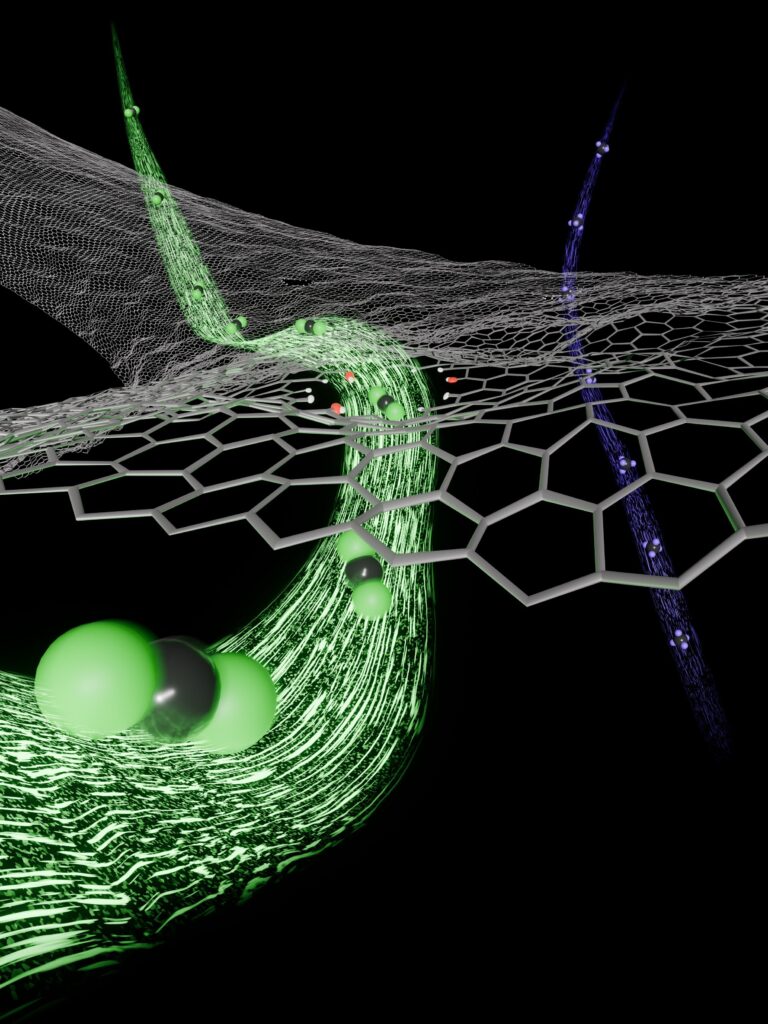
Image title: Oxygen-Functionalized Graphene Pores Enabling Selective CO2 Transport for CO2/CH4 Separation
Image caption: Introducing oxygen groups at graphene pore edges strengthens carbon dioxide (CO2) selectivity over methane (CH4), allowing rapid gas flow while efficiently removing impurities from gas mixtures.
Image credit: Associate Professor Tomonori Ohba from Chiba University, Japan
Source link: N/A
Image license: Original content
Usage restrictions: Cannot be reused without permission.
As we shift toward more sustainable fuels, natural gas and biogas, which mainly contain methane (CH4), have become important sources of energy and raw materials for chemical production. However, these gases also contain impurities that must be removed before use. One major contaminant is carbon dioxide (CO2), which reduces the energy content of the gas and can cause corrosion in pipelines.
One promising method for efficiently separating CO2 from these gases is filtration using graphene membranes containing nanosized pores. Graphene is particularly attractive as a filtration material because of its exceptional mechanical strength and chemical and thermal stability. While pristine graphene is naturally impermeable to gases, introducing pores allows it to selectively separate gas molecules.
Now, researchers at Chiba University, Japan, led by Associate Professor Tomonori Ohba, along with Shunsuke Hasumi from the Graduate School of Science, Chiba University, have shown how ultrathin oxygen-functionalized graphene membranes can efficiently separate CO2 from CH4. Their study was made available online on December 8, 2025, and will be published in Volume 248 of the journal Carbon on February 5, 2026. The findings offer a potential pathway toward next-generation gas purification systems.
“Membrane separation has emerged as a promising and environmentally friendly technique that provides high selectivity and permeability. Graphene could be an extremely permeable gas separation membrane; however, its practical implementation and separation ability require further improvement,” says Assoc. Prof. Ohba.
The pore size of the graphene membrane was found to be critical for effective gas separation. If the pores are too large, both CO2 and CH4 pass through indiscriminately. To investigate this effect, the researchers measured the flow of CO2 and CH4 through graphene membranes mounted in a custom-built mass spectrometer system. Alongside these experiments, they conducted detailed computer simulations that tracked the movement of CO2 and CH4 molecules through graphene pores ranging from 0.21 to 0.99 nanometers. These calculations accounted for molecular interactions and long-range Coulomb interactions, allowing the team to systematically examine how pore diameter and surface chemistry influence gas permeation.
The simulation results showed that porous graphene membranes exhibit extremely high permeability, allowing gases to pass through very easily. However, when pore sizes exceeded about 0.5 nanometers, the membranes showed little ability to distinguish between CO2 and CH4. Only pores closer to 0.4 nanometers exhibited noticeable selectivity. Experimental tests confirmed this overall trend, although the measured CO2 permeability was lower than predicted by simulations because the experimental membranes consisted of multiple graphene layers instead of a single layer.
A key factor explaining the difference between simulations and experiments was the presence of oxygen functional groups on real graphene membranes. These oxygen-containing groups naturally form at defects and edges in graphene. When the researchers incorporated these oxygen-modified regions into their simulations, the membrane allowed CO2 to pass through more easily while also separating it more effectively from CH4.
To confirm this experimentally, the researchers treated graphene membranes with oxygen plasma, intentionally introducing oxygen functional groups. The modified membranes showed significantly improved separation performance, closely matching the simulation results.
The enhanced selectivity was attributed to stronger interactions between CO2 molecules and oxygen functional groups at the edges of graphene pores. CO2 is more strongly attracted to these oxygen sites than CH4, allowing it to pass through the membrane more readily, even when pore sizes are relatively large.
The findings demonstrate that graphene membranes can achieve improved CO2 and CH4 separation while maintaining high permeability and flow rates, opening the door to industrial applications. “Such technology could lead to cheaper and cleaner energy by making biogas and natural gas purification more efficient, lowering CO2 emissions through high-efficiency separation, and reducing the energy required for industrial gas processing,” says Assoc. Prof. Ohba.
To see more news from Chiba University, click here.
About Associate Professor Tomonori Ohba from Chiba University, Japan
Tomonori Ohba is an Associate Professor and Director of the Ohba Research Group at the Department of Chemistry, Graduate School of Science, Chiba University, Japan. He primarily works in the field of physical chemistry, aiming to elucidate chemical phenomena at the nanomolecular level by employing advanced theoretical and experimental methods. He also explores nanospaces to control molecular motion, investigate molecular behavior, and discover new molecular reactivities. His extensive research work, published in numerous reputable journals, has been cited more than 5,000 times.
Funding:
This research was supported by JSPS KAKENHI (Grant Number: 23H01999).
Reference:
Title of original paper: Enhancing the CO2/CH4 gas separation performance of graphene membranes via oxygen functionalization
Authors: Shunsuke Hasumi and Tomonori Ohba
Affiliations: Graduate School of Science, Chiba University, Japan
Journal: Carbon
DOI: 10.1016/j.carbon.2025.121147
Contact: Tomonori Ohba
Graduate School of Science, Chiba University, Japan
Email: ohba@chiba-u.jp
Academic Research & Innovation Management Organization (IMO), Chiba University
Address: 1-33 Yayoi, Inage, Chiba 263-8522, Japan
Email: cn-info@chiba-u.jp
Recommend
-

Interdisciplinary Collaborations to Solve Social Issues: Frontier Bioresearch at Chiba University
2023.03.17
-

What causes nations and regions to perceive the COVID-19 crisis differently?〜Insights from the Humanities and Social Sciences Needed for Disaster Management Research
2022.12.12
-

The Global Goal of Carbon Neutrality by 2050 (Part 1): Universities as Agents of Change
2023.07.12

