





Contents
Share


A collaboration among Tohoku University, Chiba University, and the Chiba Institute of Technology has embarked on a pioneering search for the sources of high-energy neutrinos in the Universe.
The origins of extremely high-energy particles that fill the Universe—such as protons, electrons, and neutrinos—remain one of the longest-standing mysteries in modern astrophysics. A leading hypothesis suggests that “explosive transients,” including massive stellar explosions (supernovae) and tidal disruption events (TDEs) caused by stars being torn apart by black holes, could be the cosmic engines driving these energetic particles. Although this idea has been widely discussed, its rigorous testing is still in progress.
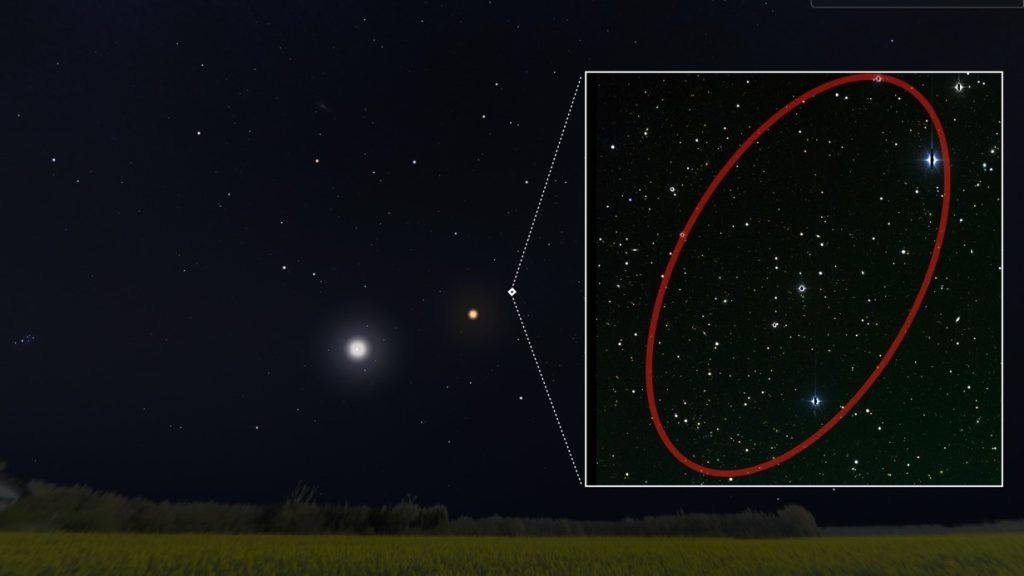
Image title: Arrival direction of a high-energy neutrino multiplet event determined by the IceCube experiment, overlaid on the visible night sky (generated with Stellarium).
Image caption: The right panel shows a zoomed-in optical image of the same region. The red ellipse indicates the 1σ uncertainty estimated by IceCube.
Image credit: Stellarium, Zwicky Transient Facility
Usage Restrictions: Cannot be reused without permission.
A research team has conducted the first systematic search for optical counterparts to a neutrino “multiplet,” a rare event in which multiple high-energy neutrinos are detected from the same direction within a short period. The event was observed by the IceCube Neutrino Observatory, a massive detector buried deep within the Antarctic ice.
The team—which conducted a joint study with Chiba University and the Chiba Institute of Technology—was led by Seiji Toshikage, a graduate student at Tohoku University’s Graduate School of Science, Shigeo Kimura, a professor at Tohoku University’s Frontier Research Institute for Interdisciplinary Sciences (FRIS), and Masaomi Tanaka, also from Tohoku University’s Graduate School of Science.
By analyzing wide-field optical data that coincided both spatially and temporally with the neutrino multiplet, the researchers sought visible evidence of possible astrophysical sources. However, their investigation found no supernovae, TDEs, or other explosive transients at the corresponding times and positions.
This absence of optical counterparts is, paradoxically, highly informative. The non-detection allows the team to place stronger constraints than ever before on how bright and how long such explosive events could be if they were to produce neutrino multiplets. The findings significantly narrow the possible origins of the Universe’s most energetic particles and mark an important step toward solving one of astrophysics’ most fundamental puzzles.
“Although we didn’t find any transient sources this time, our results show that even non-detections can provide powerful insights,” said Toshikage. “They help us refine our models and guide future searches for the true sources of high-energy neutrinos.”
Looking ahead, the team plans to conduct rapid optical follow-up observations of newly detected neutrino multiplets as soon as the IceCube collaboration reports them. They expect that these efforts, building on the analysis methods developed in this study, will bring researchers closer to identifying the astrophysical engines that generate high-energy particles throughout the cosmos.
The study was published in The Astrophysical Journal on October 23, 2025.
Reference:
Title: The First Search for Astronomical Transient as a Counterpart of a Month-timescale IceCube Neutrino Multiplet Event
Authors: Seiji Toshikage, Shigeo S. Kimura, Nobuhiro Shimizu, Masaomi Tanaka, Shigeru Yoshida, Wataru Iwakiri, Tomoki Morokuma
Journal: The Astrophysical Journal
DOI: 10.3847/1538-4357/adfedf
Contact:
Seiji Toshikage
Astronomical Institute, Tohoku University
Email: seiji.toshikage@astr.tohoku.ac.jp
Nobuhiro Shimizu
Assistant Professor, International Center for Hadron Astrophysics, Chiba University, Japan
Email: shimizu@hepburn.s.chiba-u.ac.jp
Shigeru Yoshida
Professor, International Center for Hadron Astrophysics, Chiba University, Japan
Email: syoshida@hepburn.s.chiba-u.ac.jp
Wataru Iwakiri
Assistant Professor, International Center for Hadron Astrophysics, Chiba University, Japan
Email: iwakiri@chiba-u.jp
Public Relations Office, Chiba University
Email: koho-press@chiba-u.jp
Recommend
-

The Science Behind Nature’s Touch: Horticultural Therapy and Community Well-Being
2025.01.14
-

The role of the Research Institute of Disaster Medicine (RIDM): The indispensable research hub for urban digital transformation
2023.02.23
-

Nurturing Teaching Personnel for Multicultural Societies: High Schools-Universities-Graduate Schools’ Tripartite Collaboration to Develop Educational Programs in ASEAN Countries
2023.08.25

