






Contents
Share


A new study investigates how artificial lighting at night shapes ecological and genetic patterns of closely related species
Artificial light at night (ALAN) can significantly affect animals by changing their physiology, behavior, and geographic distribution. However, how ALAN influences ecological and genetic patterns in closely related species remains unexplored. A new study investigated how ALAN shapes differences between two isopod species in Tokyo Bay, revealing clear ecological separation between the species based on patterns of nighttime urban lighting. The findings highlight how urban factors can be adjusted to support biodiversity.
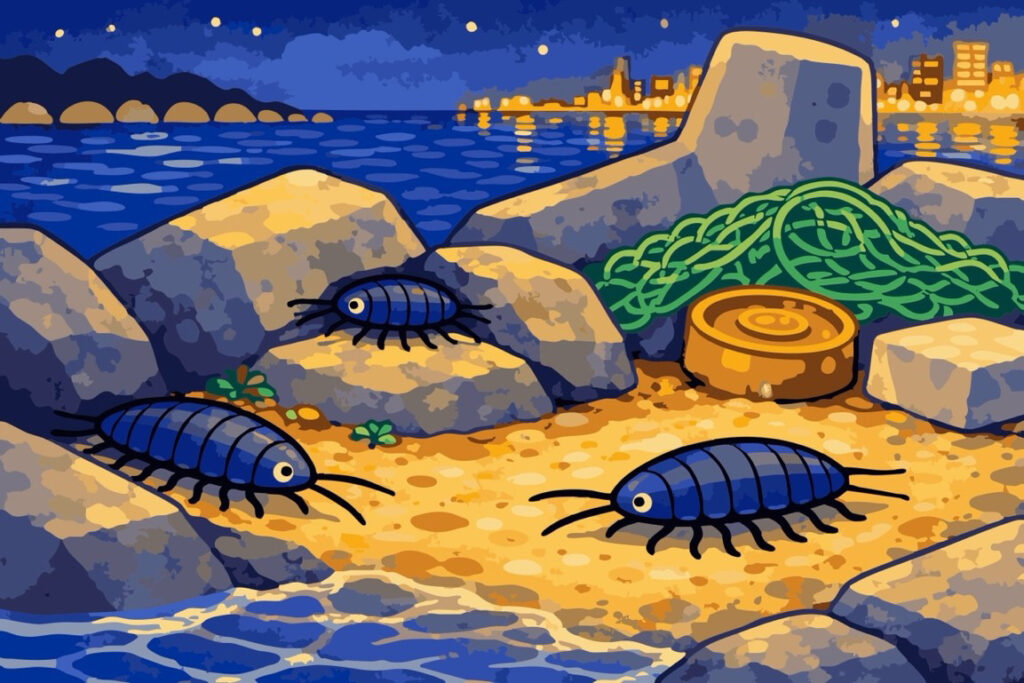
Image title: Influence of Artificial Nighttime Light on Isopod Species
Image caption: Artificial nighttime light can significantly shape genetic patterns and drive habitat segregation between closely related coastal species, providing insights into how human activities influence evolutionary processes.
Image credit: Assistant Professor Daiki Sato from Chiba University, Japan
Source link: N/A
Image license: Original content
Usage Restrictions: Cannot be reused without permission.
A key characteristic of modern human society is rapid urbanization, a process that can reshape natural environments and disrupt the habitats of many organisms. One widespread byproduct of urbanization is artificial light at night (ALAN), which has become one of the most pervasive human-made environmental disturbances. ALAN can affect animals by changing their physiology, behavior, and geographic distribution. In particular, it disrupts natural day–night cycles, circadian rhythms, predator–prey interactions, and reproduction across a wide range of species.
Coastal ecosystems are especially vulnerable to artificial nighttime lighting and intense human activity. Many studies have shown that crustaceans and other intertidal organisms are particularly sensitive to changes in light conditions, and that even small changes in nighttime light levels can profoundly affect their behavior and physiology. However, despite much research, exactly how ALAN-induced disturbances shape ecological and genetic patterns in closely related species remains unexplored.
To address this gap, Assistant Professor Daiki Sato from the Institute for Advanced Academic Research/Graduate School of Science, Chiba University, Japan, examined how ALAN disturbances relate to genetic and ecological differentiation in two closely related isopods, Ligia laticarpa and L. furcata, across Tokyo Bay. Isopods are a diverse family of crustaceans, including both land-dwelling and aquatic species. “The coastal isopods of the genus Ligia provide a promising case study for examining how urban lighting influences genetic patterns,” explains Dr. Sato. “They live in narrow intertidal zones, often on artificial structures such as seawalls and concrete blocks, where nighttime lighting can be intense. This makes them particularly exposed to human disturbance.” The findings of the study were published in the journal PNAS Nexus on February 24, 2026.
Tokyo Bay is one of the most heavily urbanized and brightly lit coastal regions in the world, providing a natural setting to explore these effects. Dr. Sato combined genomic, environmental, and experimental approaches to examine the influence of ALAN and human activity on the genetic and ecological differentiation of these two isopod species.
Genetic analyses revealed a clear ecological boundary between the two species, consistent with patterns of urban illumination. L. laticarpa was most common along the brightly lit inner-bay shorelines, while L. furcata dominated the darker outer-bay areas. Individual genetic profiles showed no evidence of recent interbreeding between the two species, indicating that they remain genetically distinct. However, examination of genetic patterns at the population level showed signs that an additional Ligia species coexists at some inner-bay sites. The signature of genetic admixture correlated with ship-traffic density, consistent with sporadic human-mediated translocation and subsequent spread. Together, these results indicate that urban environmental gradients and transport-driven movements jointly influence coastal species distributions.
Dr. Sato also conducted statistical analyses of 28 years of environmental data, showing that nighttime light, salinity, and vegetation cover were the major factors driving this partition. Notably, laboratory tests showed that long-term ALAN exposure reduced growth and activity levels in L. furcata but had limited effects on L. laticarpa.
“Together, these findings highlight ALAN as a potent yet underappreciated driver of ecological partitioning in coastal systems, demonstrating how human disturbances shape evolutionary processes,” remarks Dr. Sato. “Rather than viewing artificial light and other anthropogenic stressors solely as degradative forces, this work shows that some species can persist, diverge, and potentially adapt within human-altered systems.”
Overall, this research, alongside previous studies, suggests that recognizing human-mediated dynamics in coastal systems can help inform more ecologically sensitive urban planning, in which factors such as lighting can be adjusted to support, rather than undermine, biodiversity.
To see more news from Chiba University, click here.
About Assistant Professor Daiki Sato from Chiba University, Japan
Dr. Daiki Sato is an Assistant Professor at the Graduate School of Science, Chiba University, Japan. He received his Ph.D. degree from Tohoku University in 2021. His research focuses on evolutionary genomics, as well as on the genetic, molecular, and ecological mechanisms underlying the behavioral diversity of animals.
Funding:
This work was supported by the Japan Society for the Promotion of Science (grant number: 25K18517), the Obayashi Foundation (grant number: 190PM01194), and the Sumitomo Foundation (grant number: 2402511).
Reference:
Title of original paper: Metropolitan coastal night lighting aligns with ecological and plastic divergence in closely related Ligia isopods
Authors: Daiki X. Sato1,2
Affiliations:
- Institute for Advanced Academic Research, Chiba University, Japan
- Graduate School of Science, Chiba University, Japan
Journal: PNAS Nexus
DOI: 10.1093/pnasnexus/pgag020
Contact: Daiki Sato
Institute for Advanced Academic Research, Chiba University
Email: daiki.sato12@gmail.com
Academic Research & Innovation Management Organization (IMO), Chiba University
Address: 1-33 Yayoi, Inage, Chiba 263-8522, Japan
Email: cn-info@chiba-u.jp
Recommend
-
“Making History” with Words: Revisiting the Golden Age of Russian Literature
2025.06.09
-

Children-centered support and school operations: On the occasion of the founding of the Children and Families Agency
2023.02.15
-
“Journey of the Brave,” a new cognitive behavioral therapy program: a solution for children’s anxiety
2023.04.19

