






Contents
Share


Playing specific bat-like ultrasounds can suppress moth reproduction, offering a smart way to protect crops with minimal pesticide use
Nocturnal moths rely on hearing to escape predatory bats, yet how they respond to different bat calls has remained unclear. In a new study, researchers from Japan exposed moths to ultrasonic pulses simulating bat hunting stages and observed their flight and egg-laying behaviors. The study found that moths change how they fly and lay eggs depending on the level of danger, a finding that could help develop ultrasonic methods to protect crops from moth damage.
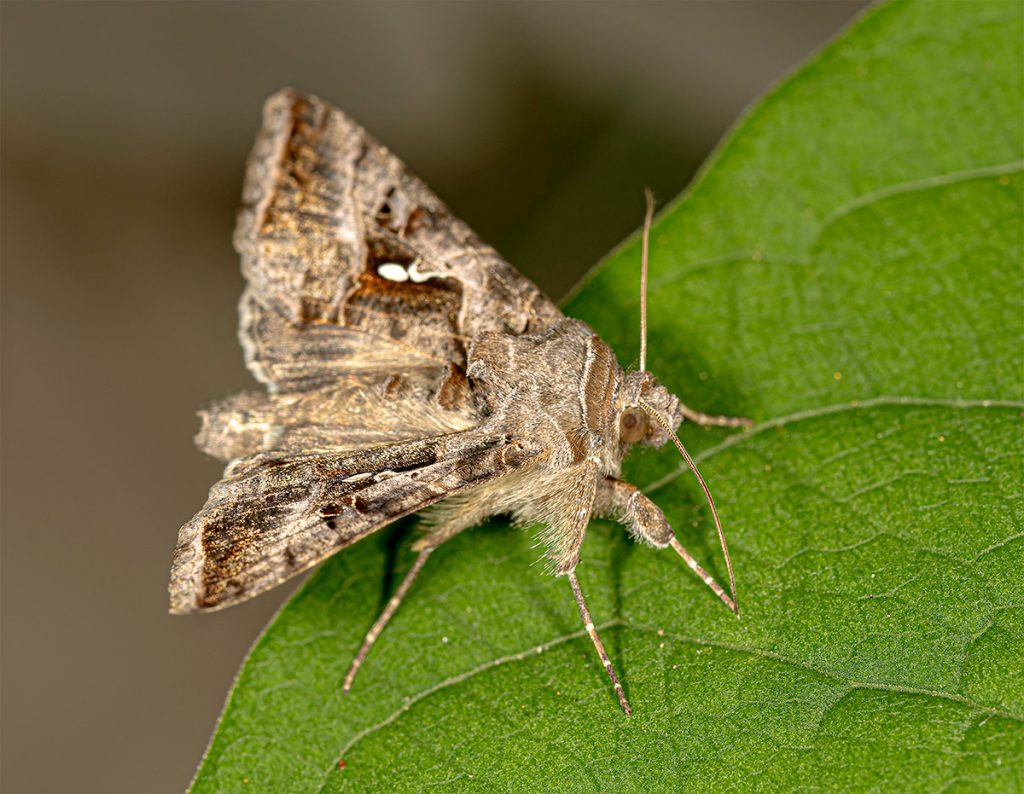
Image title: Wing-flapping behavior of Autographa nigrisigna
Image caption: Researchers played simulated bat echolocation calls in the laboratory and found that egg-bearing A. nigrisigna stopped flying when exposed to high pulse repetition rates. This behavior could be harnessed in the field to reduce crop damage and support sustainable pest control.
Image credit: Professor Masashi Nomura from Chiba University, Japan
Image license: Original content
Usage restrictions: Cannot be used without permission.
For many nocturnal moths, hearing sound waves is a matter of survival in night sky. Their ability to detect ultrasonic calls emitted by bats determines whether they escape or become prey. This predator-prey relationship has shaped the behavior, physiology, and sensory systems of both groups. Echolocating bats have developed complex call patterns to track insects in flight, while moths have evolved remarkable countermeasures, including evasive flight and sound-deflection tactics. The luna moth, for instance, spins its long hindwings to deflect the ultrasonic cries of bats and avoid capture. Although there are multiple studies on the auditory escape mechanisms of moths, the species-specific behavioral responses remain unexplored.
Against this backdrop, Professor Masashi Nomura from the Graduate School of Horticulture at Chiba University, Japan, and Dr. Ryo Nakano from the Institute for Plant Protection at the National Agriculture and Food Research Organization (NARO), Japan —who has been studying bat-moth interactions and developed ultrasonic pest control techniques (Nakano et al. 2022 PNAS)— have been investigating the long-running evolutionary contest, which they describe as a “coevolutionary arms race” between bats and moths.
A study published online in the journal Pest Management Science on September 10, 2025, by Prof. Nomura and his team, including first author Dr. Ming Siang Lem from Chiba University , sheds new light on species-specific behavioral responses of moths. The study explores how a species of noctuid moth called Autographa nigrisigna (Walker) in the subfamily Plusiinae, which is widely distributed across East and South Asia, recognizes and reacts to bat echolocation calls. Their findings could help develop ultrasonic pest management strategies in agriculture, such as reducing moth egg-laying on vegetables.
“We wanted to quantify the auditory-mediated escape mechanisms of A. nigrisigna in response to controlled ultrasonic pulses under varying pulse rate regimes to understand egg-laying and flight characteristics,” say Prof. Nomura and Dr. Nakano.
A key focus of the study was how the moths reacted to the pulse repetition rate (PRR), which measures how frequently bats emit their ultrasonic pulses. These pulse patterns signal different stages of a bat’s hunt. When bats are searching for prey, their calls are slow and widely spaced. As they close in, the pulses become faster, ending in a rapid burst known as the “terminal buzz,” just before the capture.
To explore how moths respond to these varying signals, the team recreated bat calls in the laboratory. They exposed 100 unmated adult plusiine moths—50 males and 50 females—to ultrasound pulses with different PRRs: low (1, 5, and 10 Hz), intermediate (20 and 40 Hz), and high (80 and 160 Hz).
Additionally, they tested how ultrasonic cues affect reproduction-related behavior by exposing gravid (egg-bearing) females to different PRRs. The moths adjusted their flight behavior depending on the pulse rate. At lower PRRs, they made simple avoidance turns, while at higher PRRs, they flew erratically or stopped flying altogether, showing stronger responses to sounds resembling an approaching bat. Gravid females were more likely to stop flying when exposed to higher PRRs, suggesting that moths balance survival and reproduction depending on the level of perceived danger.
“Mated females of A. nigrisigna selectively avoid ultrasonic PRRs that reflect high predation risk, the same rates emitted by bats during prey pursuit. This adaptive response highlights the evolutionary balance between predator evasion and reproductive investment in nocturnal moths,” says Dr. Lem.
Ultimately, this finding gives us more insight into one of nature’s most enduring rivalries: the silent evolutionary battle between bats and moths that has shaped both species for more than 60 million years. “Installing the ultrasonic emitters in fields to reduce nighttime moth activity could lead to reduced pesticide use. If ultrasonic treatment works for other pest moths as well, environmentally friendly pest control may become a reality,” say Prof. Nomura and Dr. Nakano.
By taking inspiration from nature’s own defense mechanisms, such as echolocation, this study could lead to novel pest control strategies and support more sustainable farming.
To see more news from Chiba University, click here.
About Professor Masashi Nomura from Chiba University
Dr. Masashi Nomura is a Professor and Vice Dean at the Graduate School of Horticulture, Chiba University, Japan. His research focuses on environmentally friendly pest management, employing biological and physical control methods to reduce pest populations without relying solely on chemical pesticides, and integrating these approaches through Integrated Pest Management. He also studies insect molecular phylogenetics and intraspecific variation, uncovering species differentiation and cryptic species within widely distributed insects. His current interests include Wolbachia lineage replacement, ultraviolet radiation effects on beneficial insects, and genetic variation in dragonflies.
Funding:
This study was financially supported by the Agri-Net Scholarship Program under the Japan International Cooperation Agency (JICA) (Grant Number D2202241).
Reference:
Title of original paper: Ultrasonic pulse repetition rates triggering escape responses of a moth pest
Authors: Ming Siang Lem1, Ryo Nakano2, and Masashi Nomura1
Affiliations:
- Laboratory of Applied Entomology, Graduate School of Horticulture, Chiba University, Japan
- Migratory Insect Pests and Advanced Control Technology Group, Institute for Plant Protection, NARO, Japan
Journal: Pest Management Science
DOI: 10.1002/ps.70204
Contact: Masashi Nomura
Graduate School of Horticulture, Chiba University, Japan
Email: nomuram@faculty.chiba-u.jp
Academic Research & Innovation Management Organization (IMO), Chiba University
Address: 1-33 Yayoi, Inage, Chiba 263-8522, Japan
Email: cn-info@chiba-u.jp
Institute for Plant Protection, National Agriculture and Food Research Organization (NARO)
Address: 3-1-3 Kannondai, Tsukuba, Ibaraki 305-8602, Japan
https://www.naro.go.jp/english/inquiry/index.html
Recommend
-

Exploring the uncharted waters in paleontology: Studying “Fossil Poop” as an academic survival strategy
2023.01.25
-

Listening to the Voices of the Universe: Multi-Messenger Astrophysics with Gravitational and Electromagnetic Waves
2025.05.16
-

The Joy of Work and The Delight of Nurturing: From Social Farming to Universal Farms
2025.02.10

